Trail News/ What's New?


Lewis and Clark Trail "Re-live the Adventure"

From the Journals of
Lewis and Clark


PODCAST

Directory

Search the Trail

   
Travel the Trail 
Travel Stories
Travel the Trail ~ From Sea to Shining Sea
Events & Exhibits
Eastern Legacy Trail
Lewis & Clark in Illinois
Lewis & Clark in Missouri
Lewis & Clark in Kansas
Lewis & Clark in Iowa
Lewis & Clark in Nebraska
Lewis & Clark on the Missouri National Recreational River
Lewis & Clark in
South Dakota
Lewis & Clark in
North Dakota
Lewis & Clark in Montana
Lewis and Clark Portaging the Great Falls of the Missouri  
Lewis & Clark in Idaho
Lewis & Clark in Oregon
Lewis & Clark in Washington 
Lewis and Clark in the Northwest
Print & Play Travel Games (PDF)>>

FLINTLOCK RIFLES - SIMPLE/BASIC/NECESSARY

The basic goal of the flintlock is simple: to create a spark that can light the gunpowder stored in the barrel of the gun. To create this spark, the flintlock uses the "flint and steel" approach. The idea behind flint and steel is straightforward. Flint is an amazingly hard form of rock. If you strike iron or steel with flint, the flint flakes off tiny particles of iron. The force of the blow and the friction it creates actually ignites the iron, and it burns rapidly to form Fe3O4. The sparks that you see are the hot specks of iron burning! If these sparks come near gunpowder, they will ignite it.

The flintlock therefore needs:

A piece of flint

A piece of steel

A place for the sparks to touch gunpowder

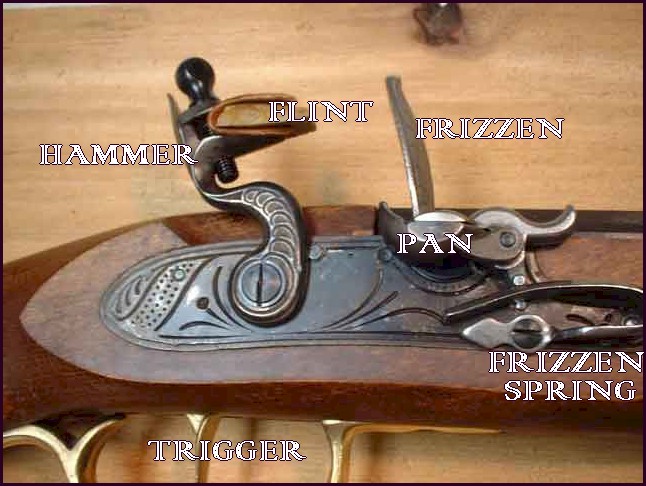
The flint needs to move at high speed and strike the steel in such a way that the sparks fall into some gunpowder. You can see the four parts that make this happen.   Click here to view diagram !

The main parts of a flintlock are:

The hammer, which holds and accelerates a piece of flint

The mainspring, which powers the hammer

The frizzen, which is the piece of steel the flint strikes

The pan, which is the place where a small quantity of gunpowder waits to receive the sparks

These four pieces are all that the flintlock actually needs to accomplish its goal, but all flintlocks also solve the problems of loading the pan, protecting the pan from the weather and triggering the hammer, so there are three additional parts:

The tumbler, which holds and releases the power of the mainspring and transmits it to the hammer

The sear and sear spring, which engage the tumbler and release it when someone pulls the trigger

The frizzen spring, which holds the cover attached to the frizzen over the pan to make the flintlock weatherproof

The mainspring presses against the tumbler and is able to rotate the hammer with a great deal of force. The sear engages the tumbler when the gun is cocked and holds the force of the mainspring. When you pull the trigger, it pushes the sear enough to release the tumbler and allows the hammer to drive the flint forward.

When you work with a flintlock and watch a flintlock in action you can see how all of these pieces work together. A flintlock has three positions for the hammer: un-cocked, half-cocked and fully cocked.

To use a flintlock, you follow these steps:

Half-cock the hammer.

Pour a measure of gunpowder down the barrel.

Wrap a lead ball (the bullet) in a small piece of cloth or paper and ram it down the barrel on top of the gunpowder. The bullet/cloth combination will have a nice, tight fit.

Place a small amount of gunpowder in the flintlock's pan.

Snap the frizzen in place over the pan.

Fully cock the hammer.

Pull the trigger to fire the gun.

When you fire the gun, the flint strikes the frizzen and shaves off iron to create sparks. The hammer's blow also snaps the frizzen back to expose the gunpowder in the pan. The pan's gunpowder ignites, and it flashes through a small hole in the side of the barrel to ignite the gunpowder inside the barrel. The gun fires ...BOOM!


History
Lewis & Clark 101
Lewis & Clark Biography 
Thomas Jefferson & Louisiana Purchase
Corps of Discovery
Lewis & Clark with Sacagawea
Lewis & Clark Among the Tribes
York, Clark's man-servant
Seaman, Lewis' Dog
Clark as Cartographer
Lewis as Botanist
Medical Aspects
Court Martial's
Geology on the Lewis and Clark Trail
Lewis and Clark 1806
Trail Trivia

 For Educators

Teaching & Lesson Plans
(MHS)

Learning Page
(Library of Congress)

Lewis & Clark in Columbia River Country
(WSHM)

Beyond Lewis & Clark (KSHS)

Whether you're planning a weekend getaway or a week-long vacation on the Lewis and Clark Trail, LewisandClarkTrail.com is your online connection for hotel reservations.

 Know where you want to go?  Search for the hotel rooms.

Still planning your trip? Find events on the LewisandClarkTrail.com events calendar, read travel stories and then finish planning your trip by booking your hotel and making hotel reservations at LewisandClarkTrail.com.

 Locate the hotel that meets your travel needs.

LewisandClarkTrail.com
Online Lodging
Whether you're planning a weekend getaway or a week-long vacation, LewisandClarkTrail.com is your online connection for hotel reservations. Know where you want to go? Search for the hotel rooms by clicking on the city that you plan to explore.  Still planning your trip? Find events on the LewisandClarkTrail.com events calendar, read travel stories and then finish planning your trip by booking your hotel and making hotel reservations at LewisandClarkTrail.com.

Discover the rivers of Lewis and Clark Discover the Rivers of Lewis and Clark


Discover the Lewis and Clark Trail route.  Start planning your own adventure!
Discover the
Lewis and Clark Trail route.
Start planning your 
own Adventure!

Welcome to America's # 1 Choice for Lewis and Clark History, Travel & Shopping!   LEWISANDCLARKTRAIL.COM  AS FEATURED ON : CNBC, TIME, HARLEY DAVIDSON HOG MAGAZINE, AAA TRAVEL, GROUP TRAVEL LEADER, and  NUMEROUS NEWSPAPER PUBLICATIONS ACROSS AMERICA!